
How Ultrasound is Improving the Lives of Animals
Sonography is increasingly becoming important in healthcare. But it is not only used on human patients. More and more veterinary settings are performing ultrasounds on their feline, canine and other animal patients as well.
An article from the Society of Diagnostic Medical Sonography’s magazine News Wave (“Increasing Demand for Veterinary Sonography Creating Opportunities for Sonographers” by Beth W. Orenstein) opens with how Fern Ann Delaney, RDMS, performs significantly more ultrasounds on animals compared to 13 or so years ago.
When Delaney first began as a sonographer at the University of Wisconsin in Madison’s Veterinary Medical Teaching Hospital, she was only really busy once a week with around five cases that particular day. “These days, she does between eight and 10 cases a day – everyday – and on a variety of animals from cats and dogs to ferrets and snakes,” wrote Orenstein in the 2011 article.
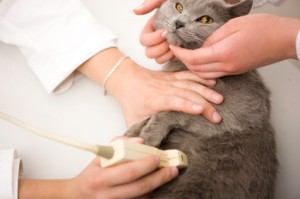
Orenstein’s article also described the mobile sonography service performed by a Eugene, Oregon-based sonographer, Tomie Timon, RDMS, RVT. Timon travels to various vet clinics and hospitals to perform abdominal ultrasounds and echocardiograms on five or six patients (like birds, dogs, snakes and guinea pigs) a day.
Furthermore, therapeutic ultrasound is growing in importance to benefit animals. For example, Jennifer Brooks in her Equine Wellness Magazine article “Making Waves” (2010) describes how she performs therapeutic ultrasound on horses. (Brooks first became a human physical therapist and then further specialized to become an equine rehab therapist).
Ultrasound’s Growing Use In Animal Healthcare
Since ultrasound is non-invasive and non-radiographic, is increasingly becoming more portable and is cheaper than other imaging technologies, (like CT and MRI technologies), sonography is becoming ever more popular a tool in animal healthcare. And it is not just sonographers or ultrasound technicians that perform the imaging tests on pets. More and more, veterinarians are also performing sonography.
Pursuing Your Training
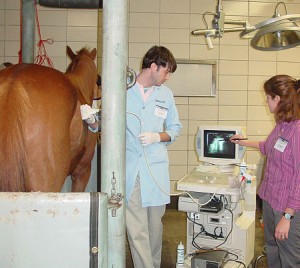 What are the requirements for veterinary ultrasound technicians? Veterinary professionals can take continuing education courses through numerous colleges, universities and associations to gain essential skills in ultrasound.
If you are considering pursuing a career as a veterinary tech, you’ll notice that numerous degree programs include at least one course in diagnostic imaging ultrasound.
The Veterinary Support Personnel Network (VSPN) encourages veterinary technicians to become trained in sonography as well.
“Veterinary technicians can increase their worth to a practice by learning these techniques,” stated the VSPN. “Acquiring the ultrasound image requires training, but you do not need to be a veterinarian to be a good ultrasonographer”.
The International Veterinary Ultrasound Society (IVUSS) promotes research and provides education in diagnostic ultrasound in veterinary medicine. You can learn more about the veterinary ultrasound certification program, including a program overview and prerequisites on their website.
Whether you are a pet owner, an aspiring sonographer, or a longtime vet, find out how ultrasound is already employed in your community. Discover how it can benefit you personally, professionally and most importantly, the animals you love.